How We Turned Demo Requests Into Real Pipeline for LineLeader - and Built a Best-in-Class LinkedIn Funnel Along the Way

LinkedIn Ads

Google Ads

Uncover hidden growth in your campaigns with zero risk.
Complete Performance Audit
Actionable Recommendations
Custom Roadmap
5.0 stars on Upwork
Client Overview
LineLeader by ChildcareCRM is a B2B SaaS company serving the childcare industry. Their platform unifies enrollment, family engagement, and center operations in one system, replacing the patchwork of spreadsheets and disconnected tools that childcare centers typically juggle to run their business. They serve 9,000+ centers, and their sweet spot is multi-location childcare operators — the larger, more sophisticated groups who feel the pain of fragmented software most acutely.
LineLeader came to us running paid media across Google and LinkedIn, but the programs weren't translating spend into business outcomes. Our mandate was to fix that on both channels: make Google generate real sales opportunities instead of noise, and turn LinkedIn from an unattributable cost center into a measurable pipeline contributor.
The Challenge
On Google, the account was busy but not productive. It was driving a healthy volume of demo requests, which looked fine on the surface, but almost none of those requests were turning into actual sales opportunities. The team was, in effect, paying for activity that never reached the pipeline. Because the account was optimizing toward a conversion event that included low-quality and spam leads, Google's algorithm was learning to chase exactly the wrong traffic — doubling down on volume that would never convert. On top of that, cost per click on the non-brand terms had crept up toward $50, making every low-quality lead even more expensive.
On LinkedIn, the core problem was attribution. LineLeader was spending real money on the channel but couldn't clearly see what it was contributing. Spend was spread across audiences that included irrelevant industries, the campaign structure wasn't built as a true funnel, and without clean measurement it was impossible to defend the channel's ROI. At one point the client's leadership was ready to cut LinkedIn entirely because no pipeline could be traced back to it — a measurement problem being mistaken for a performance problem.
What We Did
Google Ads: fix the signal, then scale the opportunities
Cut Search Partners to stop optimizing around spam. The single highest-leverage move was removing the Search Partner network, which was the main source of the junk and spam leads polluting the account. Once that low-quality traffic stopped feeding the conversion data, the algorithm could finally optimize toward real demand instead of noise, and genuine opportunity volume took off.
Optimized toward opportunities, not just form-fills. We refined conversion tracking so the account stopped rewarding early, low-intent lifecycle stages (raw leads/MQLs) and instead pointed optimization at higher-intent actions and HubSpot Opportunities — the events that actually correlate with revenue. That reframed what "success" meant to the bidding algorithm.
Restructured the account and controlled costs. We built a clean Brand vs. Nonbrand structure (core terms, secondary terms, enrollment, management, competitor conquesting), split enrollment terms into their own campaign, and applied target CPA caps across the US Search campaigns to rein in the ~$50 CPCs. We ran continuous search-term review and negative-keyword pruning to keep traffic on genuine childcare-software intent and off adjacent-but-wrong queries (student/attendance trackers, generic school software, free tools).
Steered budget toward what produces pipeline. We rebalanced spend toward the stronger performers — weighting Enrollment over Management once the data showed a materially lower cost per opportunity there — and kept shifting budget to the campaigns actually generating opportunities.
LinkedIn Ads: build a real full-funnel system
Launched a true full-funnel structure. Instead of scattered spend, we built the funnel the channel needed: awareness/prospecting at the top, high-intent retargeting to re-engage warm accounts, social-proof creative to build credibility, and dedicated lead-gen campaigns to capture demand. Each layer had a job, and each fed the next.
Fixed the targeting and the creative. A large share of spend had been reaching irrelevant industries. We rebuilt the audience targeting around LineLeader's actual core industry and decision-makers (adding an ABM layer, refining job titles, adding a location-count question to qualify multi-location operators), and cut the wasted reach. We overhauled the creative alongside it — social-proof and case-study ads, the ECE Benchmark Report lead magnet, a "Still juggling 5 platforms?" before/after concept, document and carousel ads — and tightened the lead forms (removing the phone field) to lift conversion rate.
Delivered immediate lead-gen impact at flat cost. The lead-gen campaigns responded right away: holding spend essentially flat, we drove dramatically higher lead volume and far more efficient cost per lead than the account had been getting — proof the problem had been structure and targeting, not the channel itself.
Closing the loop: HubSpot + LinkedIn attribution
Integrated HubSpot and stood up LinkedIn revenue attribution. Finally, we helped LineLeader integrate HubSpot and set up the LinkedIn Revenue Attribution Report (RAR), syncing conversion and lifecycle data between the two. For the first time they could see which campaigns were actually contributing to pipeline creation, giving leadership a clear, defensible view of each channel's ROI — and turning the "should we even keep LinkedIn?" conversation into a data-backed one.
The Results
Google opportunity volume exploded once Search Partners were cut and the account was optimizing toward real intent — the HubSpot Opps line climbs sharply from the point our changes went in, alongside strong conversion growth.
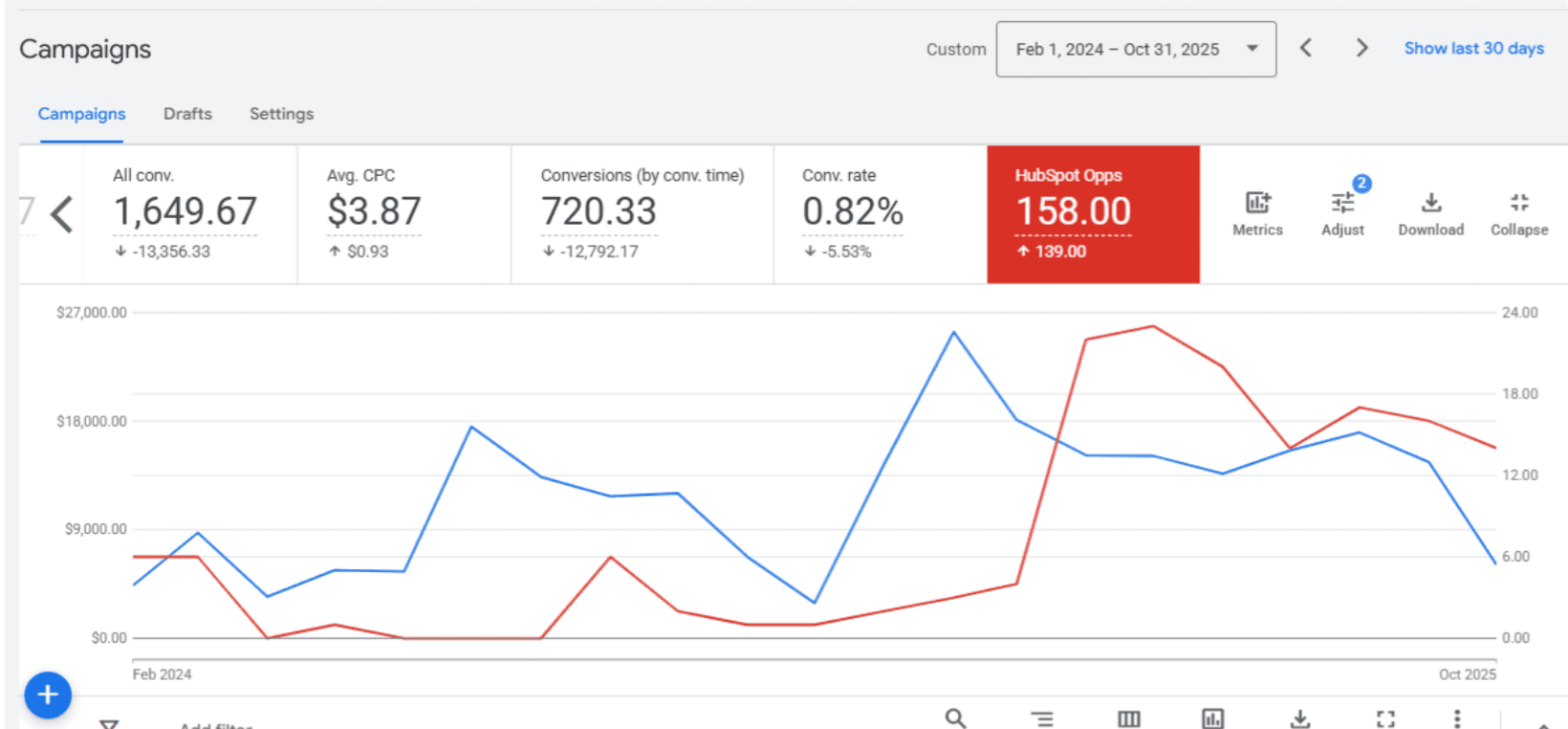
Cost per conversion improved dramatically on Google as the junk traffic dropped out — in one representative week conversions doubled (5 → 11) while cost per conversion fell 56% to $245, and brand cost-per-opportunity ran as low as $50–$86.
LinkedIn lead generation jumped at flat spend. Holding budget roughly level, lead volume and efficiency improved sharply versus where the account started, with cost per lead compressing significantly as the wasted industry spend was removed.
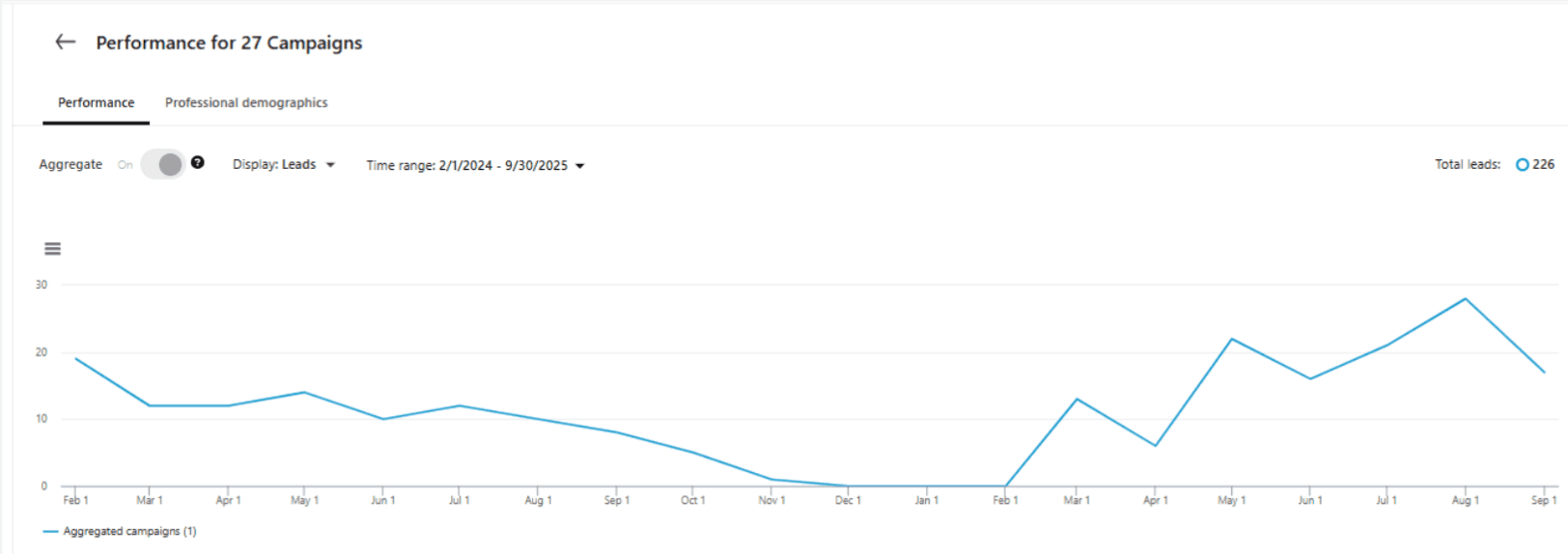
Full attribution visibility. With HubSpot integrated and the LinkedIn RAR live, LineLeader can now see campaign-level pipeline contribution across both channels — the ROI clarity they were missing at the start.
Key Outcomes
Cut Search Partners on Google, ending the spam-lead problem that was mis-training the algorithm — opportunity volume took off
Re-pointed optimization from raw demo requests to HubSpot Opportunities, so spend chases pipeline, not noise
Doubled weekly Google conversions while cutting cost per conversion ~56% and capping runaway CPCs
Rebuilt LinkedIn into a true full-funnel system: awareness, high-intent retargeting, social proof, and lead gen
Eliminated wasted LinkedIn spend on irrelevant industries and rebuilt audiences around real decision-makers
Drove much higher LinkedIn lead volume at flat cost through better structure, targeting, and creative
Integrated HubSpot and launched the LinkedIn RAR, giving leadership clear campaign-level pipeline attribution for the first time
Top-Performing Creative (LinkedIn)
Customer testimonial video — Tommy Ferrari / Lightbridge Academy story on scaling to 133+ locations with LineLeader (social proof)
ECE Benchmark Report lead magnet — "Download the 11th annual ECE Benchmark Report" (top-of-funnel lead gen)
"Still Juggling 5 Platforms to Run Your Center?" before/after — the unified-platform message that captures LineLeader's core value prop

The Bottom Line
LineLeader had two classic B2B paid-media problems hiding under a surface that looked okay: a Google account optimizing toward the wrong conversion, and a LinkedIn program nobody could measure. We fixed the Google signal at its source — cutting Search Partners, re-pointing optimization at real opportunities, and controlling cost — which turned a stream of dead-end demo requests into genuine, growing pipeline. On LinkedIn, we rebuilt the whole funnel, cut the wasted industry spend, refreshed the creative, and then closed the loop with HubSpot and the LinkedIn attribution report so the channel could finally prove its worth. The playbook was the same as always: fix what you're optimizing toward, build the funnel, cut the waste, and make the results measurable.
Related Case Studies


View Case
Finance
Scaling A Quiz Funnel for M&A Advisory Dropped Cost Per Lead to a Third

Meta Ads


View Case
B2B
From $200–$300 Per Lead to $90: How We Rebuilt CEO Life's Member Acquisition in the Most Expensive Markets in the Country
Meta Ads


View Case
Local Services