How We Scaled a Non-Profit’s Two-Sided Marketplace Across Meta and Google Ads

Google Ads

Meta Ads

Uncover hidden growth in your campaigns with zero risk.
Complete Performance Audit
Actionable Recommendations
Custom Roadmap
5.0 stars on Upwork
Client Overview
Path-Now is a California platform that custom-matches individuals with autism and intellectual and developmental disabilities (IDD) to local service providers — from independent living and job coaching to recreational day programs. It's a program of Adjoin, a nonprofit with a 40+ year history in the IDD community and a 4-star Charity Navigator rating. The platform is free for individuals and carries the largest provider network in the state, over 9,600 organizations. Revenue comes from the other side of the marketplace: service providers pay a monthly subscription to claim a profile and connect with the families who need them.
That two-sided model is the whole challenge and the whole opportunity. Path-Now has to grow individual sign-ups and provider subscriptions at the same time, because each side makes the other more valuable. Jumpstart ROI runs their paid acquisition across both channels.
The Challenge
Path-Now came to us having already run paid ads with a previous agency and stopped, because they weren't making real progress toward their goals. Three problems sat underneath that — and they showed up across both channels.
A two-sided marketplace is hard to advertise
One generic campaign can't speak to both a parent looking for autism services and a provider organization deciding whether to pay for a subscription. The previous setup wasn't separating those audiences, so neither message landed.
Tracking wasn't in place
On Meta, Google Tag Manager wasn't installed on the account-creation and application pages, so the platform couldn't see who actually signed up or subscribed. On Google, there was no meaningful lead tracking at all — effectively zero tracked leads. Without measurement, you optimize blind and can't tell a cheap click from a real account.
A free product from a nonprofit invites doubt
Families wondered whether it was legitimate, whether their information was safe, and whether something free was really worth it. Providers wondered whether families would actually find them there. The messaging had to overcome trust objections on both sides, not just drive clicks.
What We Did
Meta — two clean funnels, rebuilt tracking, trust-led creative
Split the account by audience. A "Clients" campaign for individuals and families, optimized for free profile creation, and a separate B2B "Providers" campaign optimized for application submissions — each with its own audiences, creative, and offer so the message matched the reader.
Rebuilt tracking around the real funnel. Dedicated landing pages for each side and a full conversion path: sign-up → email verification → completed profile. We shifted the primary optimization event away from raw sign-ups toward completed profiles, so the platform learned to find quality accounts, not just cheap clicks.
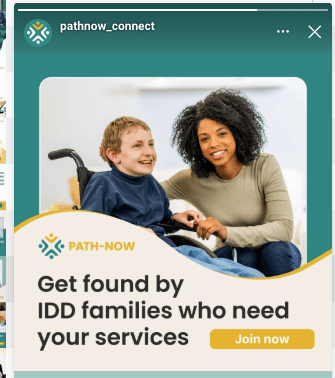
Led with trust and "free." On the individual side, creative leaned into the free offer and the scale of the network ("Connect with local autism service providers for free," "Over 9,600 local providers across California") to answer legitimacy and value objections up front. On the provider side, we flipped the value prop to their self-interest: "Get found by IDD families who need your services."
Tested continuously and scaled the winners. Both campaigns run as structured creative tests, cycling batches of statics and video, cutting underperformers, and concentrating budget on what converts — which is why costs are still falling instead of fatiguing.
Google — service-level structure and conversion tracking from scratch
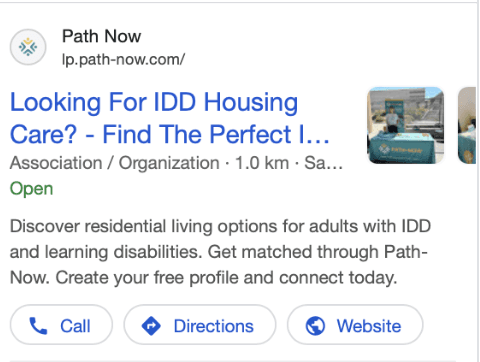
Conducted deep keyword research around Path-Now's specific service lines to find high-intent search demand
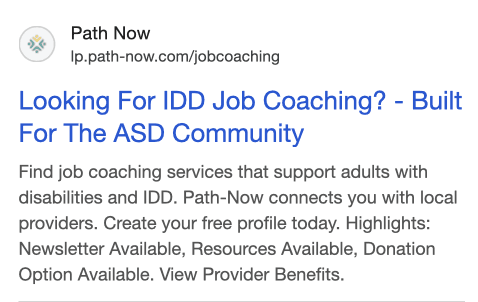
Structured 3 separate campaigns, each aligned to one core service, so performance could be measured and optimized at the service level
Implemented conversion tracking to capture and attribute lead actions from Google Ads — turning an untracked channel into a measurable one
Matched keyword themes, ad messaging, and landing-page intent to bring in more qualified traffic, then used the data to keep cost per conversion efficient
The Results
Meta — cheaper on both sides, and still improving
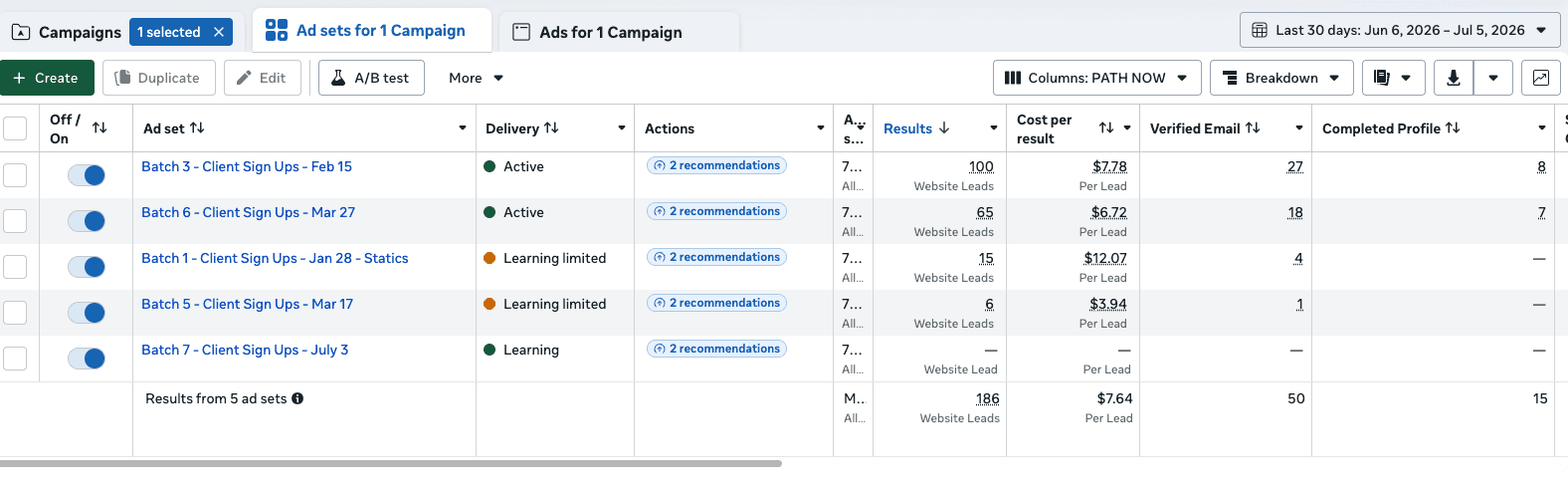
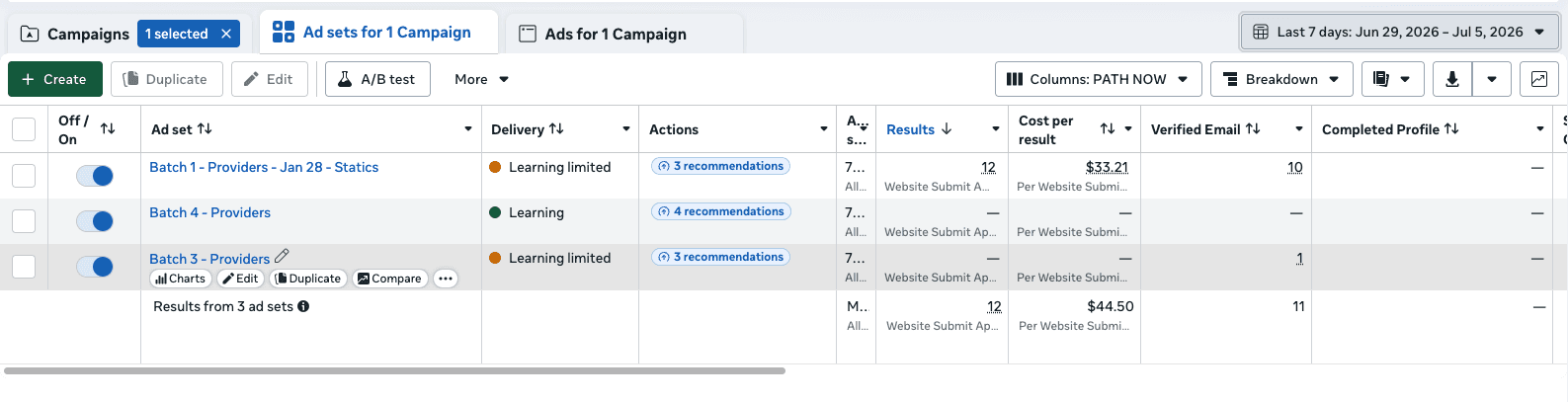
The results are strong and, importantly, still improving as spend scales — the B2B Provider campaign has scaled from $25/day to $70/day while performance held stable.
Clients (individuals): 188 sign-ups at a $7.86 cost per lead over 30 days at a 4.48% CTR — far below the client's $25–$100 target range. In the most recent 7 days that dropped to $5.56 per lead at a 5.21% CTR: cheaper and more engaging, not tiring out.
Providers (B2B): paid-provider application submissions at $68.80 over 30 days, sharpening to $44.50 in the last 7 days as testing found the winning creative — a meaningful move on the harder, higher-value action.

Google — from 0 tracked leads to a scalable channel
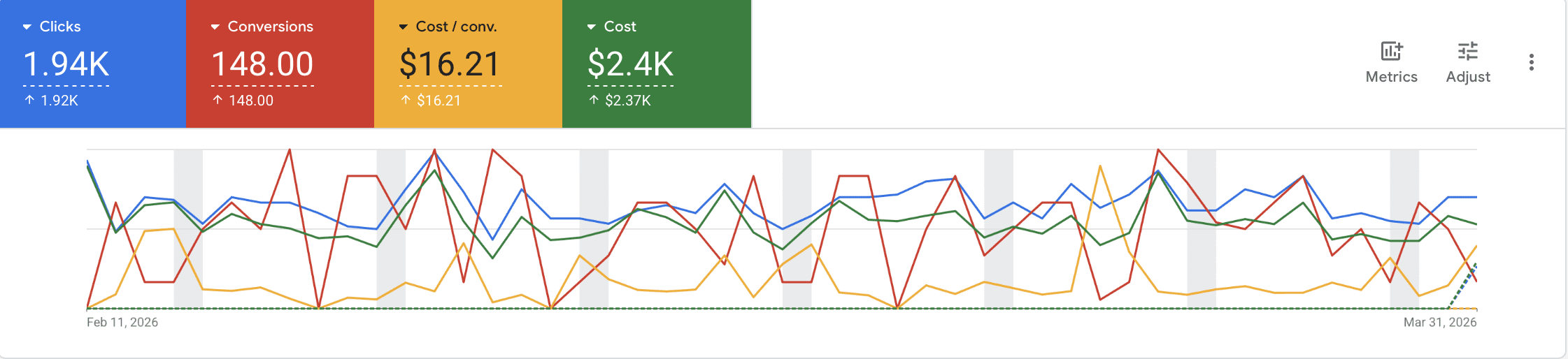
Nearly 150 tracked conversions (148) generated in under 2 months
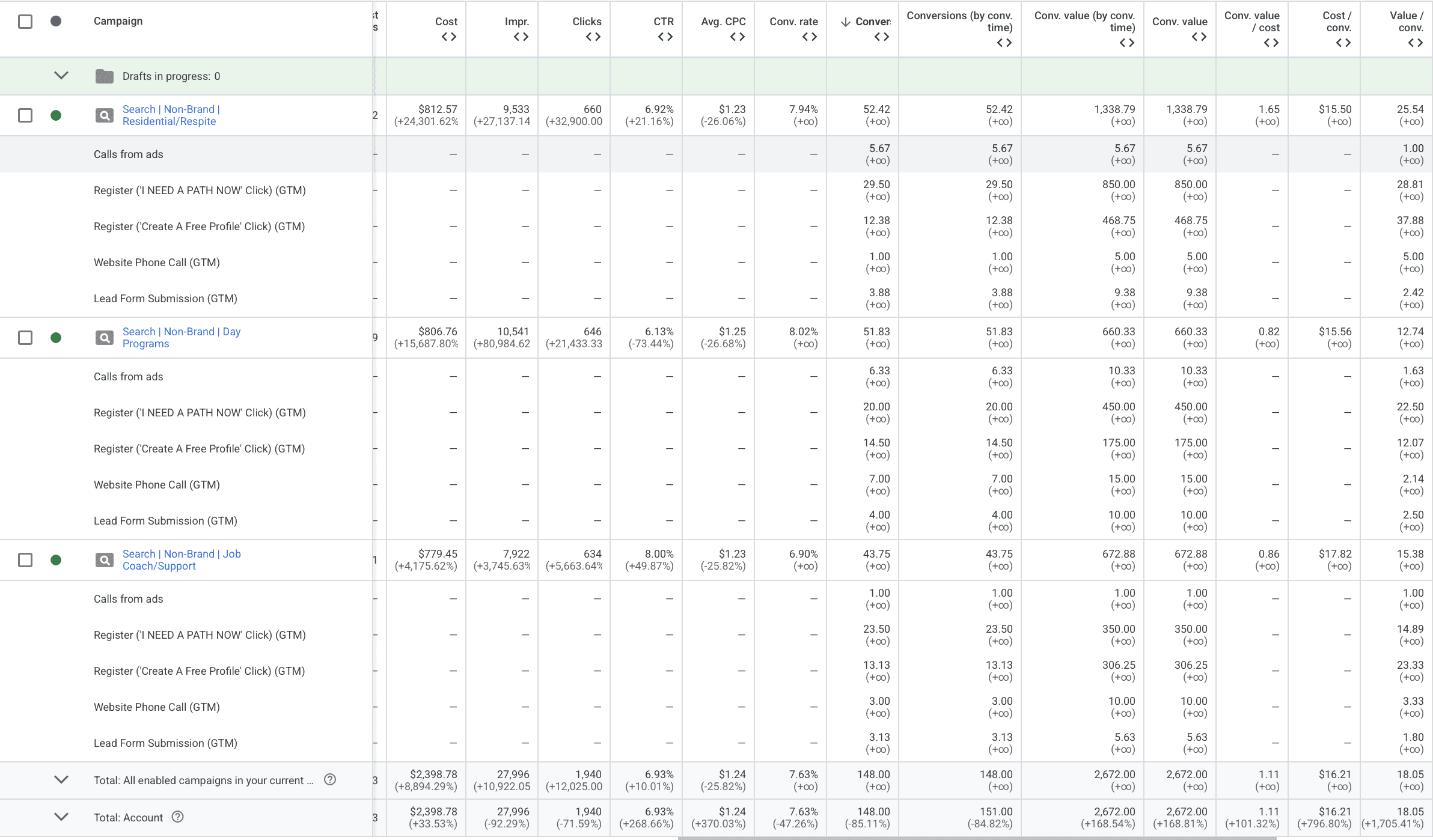
$16.21 cost per conversion — under $20 across all three service campaigns — on $2,398.78 in spend (1.94K clicks)
Went from no tracked leads to a measurable, scalable lead-generation channel
By service campaign: Residential/Respite at $15.50/conv (52.4 conversions), Day Programs at $15.56/conv (51.8), and Job Coach/Support at $17.82/conv (43.8).
Key Outcomes
Turned a stalled, previously-abandoned ad program into a working two-sided engine
Separated the marketplace into distinct client and provider funnels so each message lands
Built conversion tracking from scratch on Google and rebuilt it on Meta around completed profiles
Drove individual sign-ups at $5–8 vs. a $25–$100 target, and provider applications down to $44.50
Delivered 148 Google conversions under $20 each across three service lines
Kept costs falling as spend scales — the sign of a system that's improving, not fatiguing
Top-Performing Creative
Meta
"Connect with local autism service providers for free" — individual-side ad leading with the free offer and the 9,600+ provider network to answer trust and value objections
"Get found by IDD families who need your services" — provider-side ad flipping the value prop to the provider's self-interest
Search | Non-Brand | Residential/Respite, Day Programs, and Job Coach/Support — three intent-matched search campaigns, each mapped to a core service line and landing page

The Bottom Line
Path-Now's two-sided marketplace is exactly the kind of account where generic advertising fails: two audiences, real trust objections, and no measurement to steer by. We rebuilt it into separate client and provider funnels, put tracking underneath both channels, and led with the messages each side actually needed to hear. The payoff is leads well under target on both sides — and costs that keep falling as we scale. The playbook was the same on Meta and Google: separate the audiences, fix the tracking, cut what isn't working, and scale what converts.
Related Case Studies


View Case
B2B
More Than Double the Demo Requests at Half the Cost: Rebuilding Belfry's Meta Program Around Measurement

View Case
Legal
Building Google Ads From Scratch for Business Law Firm at a 15.08% Conversion Rate
Google Ads


View Case
B2B
Turning Meta Into a Scalable Acquisition Channel for Royalty Team Gear
Meta Ads